February 2026
By Andrew Wootton
With several varroa detections in metropolitan Melbourne and the Victorian varroa heat map looking like a Christmas pudding, we can safely assume that you either already have mites in your hive or will have this season.
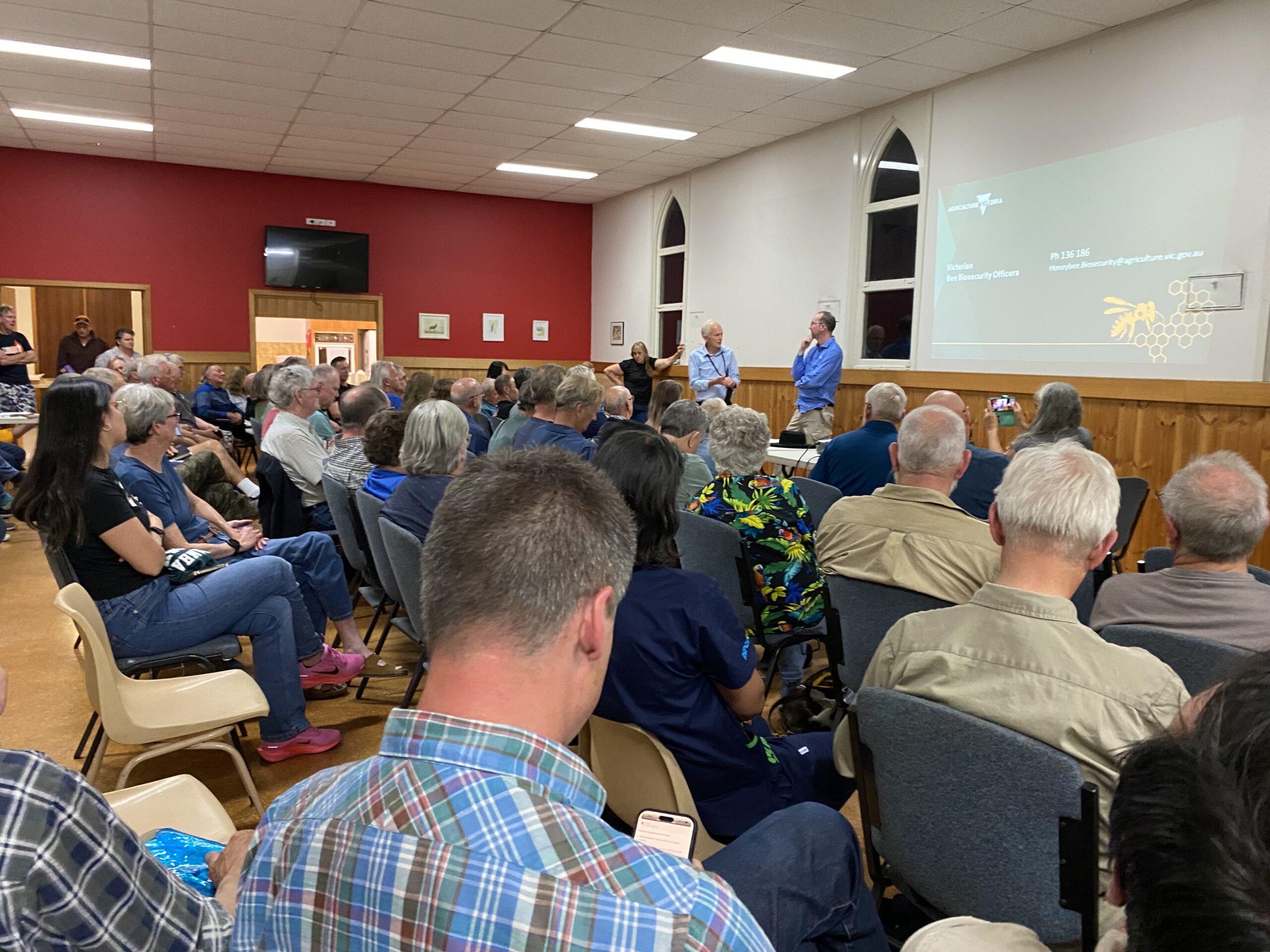
So it was encouraging to attend the Melbourne Section club meeting on the 29th January and see it packed to the rafters. Kris Fricke, one of our Varroa Development Officers (VDOs) was presenting “Varroa Management”. As I listened, two main thoughts struck me that I’d like to share.
Little did I or the ABJ editor realise when I wrote an article on mites for the ABJ last August that this would turn into a “column” and that I would become self-elected commentator on all things varroa. But here we are and I’ve churned out articles every month. I assume they are read, although given the feedback rate of one comment every 2 articles, it sometimes feels like casting into a black hole.
My first and foremost thought was, what a great job the VDOs have done. This meeting was Kris’ final act as VDO; the emergency response funding has come to its long-heralded finish. What a wonderful program the transition to management has delivered. Australia surely has the best-prepared beekeepers in the world.
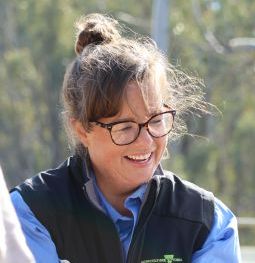
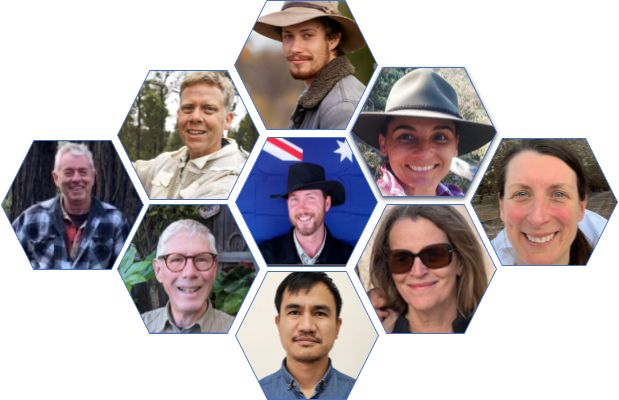
Congratulations to all the team, led by Jennifer Ryan and including Ashton Edgley, Kris Fricke, Ally Driessen, Scott Denno, Tony Wilsmore, Don McArthur, Krista Mogensen, Peter Gatehouse, Joe Riordan, Buffie Harris, Lachie Wakefield and Junie Rey Bag-ayan. Our heartfelt thanks for your efforts, goodwill and good humour. You will be sorely missed (see later for what is to come*).
My second thought, there is still a great deal of magical thinking amongst our beekeeping audience. People are still asking questions about whether rhubarb leaves work and whether resistant bees are available. No and no. If you don’t monitor and treat appropriately, your bees will die. Many overseas beekeepers have commented that their principal function nowadays is mite management rather than bee wrangling. We need to get used to this idea.
There were questions about the accuracy of the mite heatmap. This has served its purpose, to warn when mites have turned up in your locale. They are here now, so it doesn’t really matter what’s going on around you anymore; what matters is what you find in your own hives. This may not be strictly true for the few regions that are still mite-detection-free, but for the vast majority of Victoria, this holds. And it’s probably not worth obsessing whether a swarm you catch or a queen you bring in is varroa free – mites will be coming in through the front door of your hives, you need regular monitoring and management.
The meeting was also a chance to reflect on my own plans here in Melbourne (not forgetting ”no plan survives first contact with the enemy”). We are half way through the season and my hives are still recording negative counts. I expect this to change in the next 2-3 months and low mite numbers will show. As soon as this happens, I’ll use slow release oxalic acid strips in all hives in the affected apiary. Assuming I catch early at low mite numbers, and given that the strips are effective over 6 weeks, this should get me to the end of the season in good shape. If the numbers don’t remain low, I can resort to a hard chemical to ensure my bees go into winter in the best possible shape. Next season, in September, I will add a drone frame to each hive and remove and freeze it 3 weeks later. This should ensure a good start with relatively low numbers. Meanwhile, what will be the situation in feral colonies? Throughout the remainder of this season, their mite numbers will be building, but they are likely to survive into winter. Then, a partial brood break should slow mite reproduction and the numbers will only really take off around Christmas.
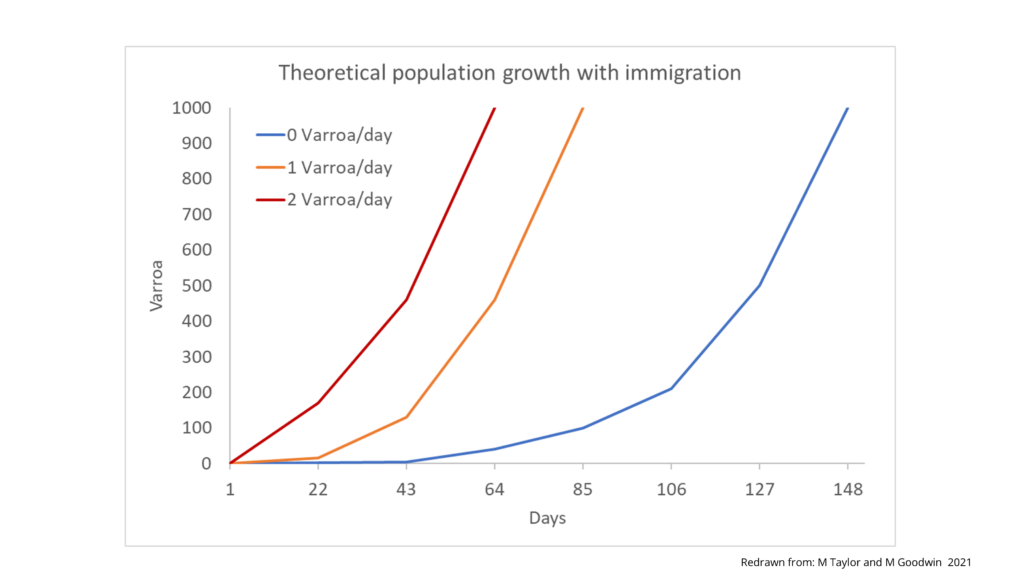
The storm will have broken, mite bombs will be exploding and management of my hives will be hardest due to mite immigration (look at its effect in Fig 1).
Priority one will be to keep my bees alive, sticking to organic treatments as long as possible, but always being ready to call on the heavy artillery of hard chemicals (not forgetting to rotate). Fortunately for me, honey production is not really a consideration and I need only focus on maintaining hive health. Ready to adapt, remembering, “everyone has a plan until they get punched in the mouth”!
*Future Resources.
Happily, the State Government has stepped up and provided additional funding for 2 biosecurity officers. Fantastic, welcome, we look forward to continuing working closely with you. Furthermore, VAA has been fortunate to secure a grant from the Honey Bee Industry Compensation Fund. This centres on biosecurity, communicating and educating Victoria’s beekeepers, whether they are VAA members or not. We are tackling this challenge with great enthusiasm.
Andrew Wootton is Vice President of the VAA and a certified master beekeeper with the Eastern Apicultural Society of N America. He first started beekeeping in the 1960s.