
March 2026
What temperature tells us about the health of a bee colony
By Theotime Colin
As beekeeping sensors become increasingly available and affordable, the pollination industry is eyeing the promise of a reduction of beekeeping costs and colony losses (https://www.tandfonline.com/doi/full/10.1080/00218839.2025.2552530) . Recent advances in our understanding of temperature regulation by bee colonies provide the first tangible opportunities for practical applications of hive temperature sensors.
A healthy bee colony with a queen and reasonable brood population keeps the temperature of the hive around 34.5 °C – regardless of whether it is hotter or cooler outside the hive. 34.5 °C is the optimal temperature for the development of the bee brood and healthy bee colonies excel at controlling the nest’s climate. Anything colder than 32 °C and the brood becomes sensitive to fungal infections; anything above 38 °C and the brood dries and dies.
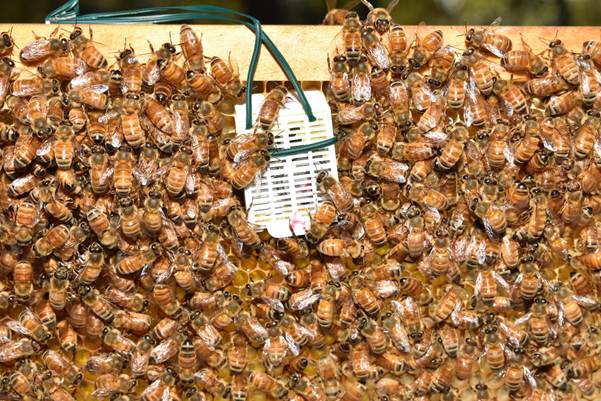
Determining whether a bee colony is healthy or not based on simple temperature measurements set against these thresholds seems easy at first glance. While this might be true in theory, measurements from temperature sensors in hives can be extremely variable in practice. Healthy hive temperature regulation is also quite complex. Bees in cooler climate do not regulate the hive temperature as tightly during winter. In cooler months, the focus of a colony is first to not freeze, and second to save enough food resources to build up in spring. It is in early spring that colony losses generally occur in cooler climates, a time when it is difficult to determine exactly what a healthy temperature in a colony would be. In spring, temperature in the nest depends a lot on microclimatic conditions, available resources, pre-winter health, and weather. It is thus difficult to determine from just a raw temperature measurement that a colony is “too cold” to be healthy. This creates a challenge for the interpretation of hive temperature sensor data, at the most critical time of the year.
Two solutions have been recently found. The method I have developed consists of comparing colonies within the same climatic area together, to pick out the weaker ones (https://www.sciencedirect.com/science/article/pii/S1574954125004546 ). With a simple temperature sensor it is easy enough to determine which hives are coldest when compared to all other hives at a same location. With this method, most colonies that are going to die can be identified weeks in advance, at any time of the year, and colonies with unusually low brood levels are also easily identified. The second method consists of measuring temperatures at different points within the hive (https://www.sciencedirect.com/science/article/pii/S1470160X24014183 ). A sensor at the center of the bee cluster should often be much warmer than one outside, so verifying that not all sensors return cold temperature readings helps confirm that a colony is healthy.
But no method is perfect. One pitfall of the first method is that if all colonies at a location were similarly unhealthy, it would be hard to detect this without manual checks. A pitfall of the second method is that there would be no warnings of sensor malfunction, and dealing with multiple sensors in each hive can add difficulties to every day beekeeping operations. This second method is also only designed for winter or early spring when outdoor temperatures are very cold. It could work outside of that, but the method will need to be fine-tuned first.
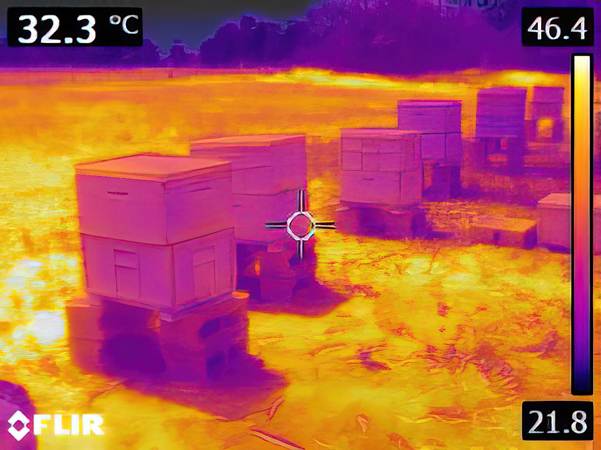
These methods should be seen as tools to get early warning signals of bee colony failure. They work in real-time while a beekeeper can only inspect a hive periodically, giving the chance to remedy bee health issues early enough to minimise losses. But beekeepers are still very much needed and should plan to check and monitor the information they receive from sensors manually and regularly.
While early warning methods in hive sensing are new and have not yet been widely implemented and tested, they will soon be. Beekeepers can already purchase hive sensors from companies but may have to inspect their data manually for a while. After reviewing the hive sensors available on the market, we advise that beekeepers should first trial sensors on a small scale to determine whether they match their needs and meet their expectations. We also advise that beekeepers should prefer sensors from Australian companies like HiveIQ, BeeStar, BeeRight, or well-established overseas companies with local Australian resellers so that they can access support when needed.
This project is funded by Hort Innovation, using the Hort Frontiers Pollination Fund research and development levy, contributions from the Australian Government and co-investment from Macquarie University. Hort Innovation is the grower-owned, not-for-profit research and development corporation for Australian horticulture.