
March 2026
Andrew Wootton
First the bad news
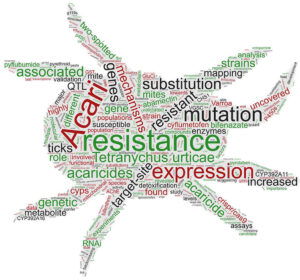
Reproduced under Creative Commons Licence.
De Rouck, S., İnak, E., Dermauw, W. and Van Leeuwen, T., 2023. A review of the molecular mechanisms of acaricide resistance in mites and ticks. Insect Biochemistry and Molecular Biology, 159, p.103981.
I wrote of the dangers of miticide resistance developing in Australia in December’s ABJ.[1] Alarmingly, resistance to Bayvarol has already been reported from NSW in the AHBIC News of 11th February[2] and now on the 27th February, a further occurrence in Queensland is announced.[3]
With the NSW mites, pyrethroid resistance is due to a mutation called L925I. I’m now informed (B Giggins, personal communication, March 3, 2026) that the L925M mutation is also present. These are single amino acid substitutions at position 925 of leucine to isoleucine and methionine respectively, in the voltage gated sodium channel (VGSC) and previously reported in the USA. [4] In Europe a different mutation, L925V (leucine to valine) is seen.
A second explanation is that the mutations may have spontaneously arisen de novo due to repeated exposure of mites to pyrethroid-based treatments. This again seems somewhat unlikely due to the short timeframe of exposure (approximately 12 months) in Queensland.
Finally, there could have been a separate introduction into Australia of varroa mites carrying the resistance mutations after the 2022 incursion. The 2 locations involved are linked by hive movements, possibly supporting this.
Whatever the explanation, we have resistance emerging at an ominous rate. Further genetic surveillance in both Northern NSW and QLD regions is underway, better to understand the distribution of the resistant population. If you want to do a miticide resistance test yourself, this is fairly straightforward and Southern Cross University has a fact sheet.[5]
Now the good news
This month a new study was published showing increased effectiveness of amitraz by inhibiting efflux transporters.[6] These specialized transmembrane proteins protect cells from harmful compounds by pumping toxins and drugs out of cells, limiting their absorption and distribution. The study demonstrated that verapamil, a calcium channel blocker used in humans for the treatment of angina, synergistically increased amitraz toxicity compared to the equivalent dose of amitraz alone. However, there is a potential downside, as in honey bees the efflux transporters are also involved in mitigating pesticide toxicity. Whether we can develop efflux transporters that are specific for mites not bees, remains to be seen.
For now, rotation of treatments with differing modes of action is the only way we can avoid losing the miticides to resistance. Heed the message!
Andrew Wootton is Vice President of the VAA and a certified master beekeeper with the Eastern Apicultural Society of N America. He first started beekeeping in the 1960s.
References
[1] Wootton, A., 2025. Resisting Resistance. Australian Bee Journal, 106 (12), 12-13.
[2] https://honeybee.org.au/ahbic-industry-biosecurity-update-resistantmites/
[3] https://www.dpi.qld.gov.au/news-media/news/varroa-mite-showing-resistance-to-chemical-treatments
[4] González-Cabrera, J., Rodríguez-Vargas, S., Davies, T.E., Field, L.M., Schmehl, D., Ellis, J.D., Krieger, K. and Williamson, M.S., 2016. Novel mutations in the voltage-gated sodium channel of pyrethroid-resistant Varroa destructor populations from the Southeastern USA. PloS one, 11(5), p.e0155332.
[5] https://www.scu.edu.au/media/scu-dep/research/images/Varroa-mite-resistance-test.pdf
[6] Fine, J.D., Truong, T.T., Lucadello, M.C., Litsey, E.M., Lamas, Z., Rinkevich, F. and Nicklisch, S.C., 2026. Amitraz toxicity in resistant Varroa mites can be increased by inhibiting ABC efflux transporters. Journal of Apicultural Research, pp.1-12.