
March 2026
Fat Bodies and Vitellogenin
By Kris Fricke
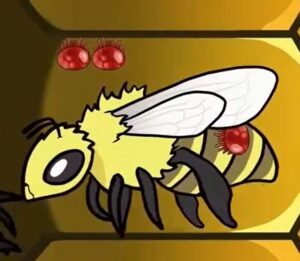
The cute animated video you’ve probably all seen during the national Varroa training sessions, other than having the bees’ hindwings in front of their forewings perpetuated another misconception by way of an almost imperceptible pause in the wrong place. In saying “Varroa feeds one the bees fat body tissue” the voice actor clearly believed he was saying the bees had body tissue that was fat. The “fat body” is in fact a specific organ in a honey bees’ body.
Because I can’t improve on this description, and haven’t looked at it with a microscope personally, let me give you an exact quote from someone who has:
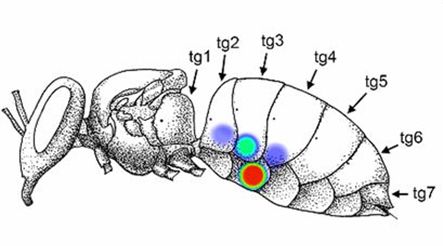
Scattered all through the body cavity of the honey bee but especially in the abdomen are irregular masses of a soft, usually white tissue composed of large, loosely united cells. These cell masses are known collectively as the fat body because the cells contain, enmeshed in their cytoplasm, small droplets of oily fat.[1]
As you can gather from the above description, while the “fat body” may perform a specific function like an organ, it is not quite one cohesive unit the way a liver is. When first discovered it was thought to be primarily storage for fats and other compounds, hence the name, but more recently it has been proven to be important to detoxification,[2] and as well the production of vitellogenin which has a major effect on honey bee health and longevity. As I explain the functions of the fat body keep in mind this organ is substantially damaged by varroa during the reproductive phase and all these functions severely hampered.
The fat body is the main producer of immune response proteins and detoxification enzymes.[3] These are the bees’ defense not only against harmful bacteria and diseases, but toxic chemicals such as pesticides which they are likely to come into contact with. Detoxification enzymes bind with unwanted foreign compounds to prevent them from performing unwanted reactions, and allow transporter enzymes to remove them[4] (to anthropomorphize a bit, one might say to take control of them, or even “grab em and throw em out”).
These chemical reactions sometimes result in byproduct molecules, often with excess oxygen atoms (such as hydrogen peroxide) which are in excess of the bee’s ability to process and hence cause “oxidative stress.” That is, these excess reactive molecules would go on to damage molecules of the structure and components of the bees’ body. How do bees process the reactive molecules? With more enzymes as well as other substances (such as glutathione and … vitellogenin), most of which are produced by, you guessed it, the fat body. In short, the fat body produces the substances that fight toxins, and the substances that clean up the unwanted waste products from the toxins being neutralized.
Vitellogenin
So vitellogenin, often abbreviated as “Vg,” has already been mentioned and you’ll have gathered it is important here. It’s universally described as a “yolk precursor” – what this actually means is that it’s a protein (produced in the liver in non-insects), which carries important components into the ovaries where it’s transformed into the major protein component of the egg yolk.
In bees, however, Vg has come to have interesting non-reproductive functions, making it very important even to non-reproductive worker bees (including even drones[5],[6]). (1) it suppresses Juvenile Hormone[7] which otherwise leads to aging (much more on this in a moment); (2) it has various immune functions such as binding and inhibiting bacteria;[8] (2) it provides antioxidant protection[9] by scavenging free radicals;[10] (3) it is the major zinc carrier in honey bee haemolymph[11] (the yellow liquid “blood” circulating within bees), and zinc is an important component of several immune enzymes; (4) high levels of Vg are a key physiological difference in long-lived winter bees, (due probably both to suppressing JH and needing more immune response); (5) and finally Vg levels even effect bees’ foraging preferences, with high levels of Vg making bees more inclined to forage for pollen over nectar.[12]
Juvenile Hormone
Famously, worker bees go through a series of jobs in their life, starting as nurse bees and ending as field bees. There are physiological differences between nurse bees and non-nurse bees (active hypopharyngeal glands on the nurse bees for example), and it’s shown that bees who had aged out of being nurse bees can return to it (including the physiological adjustments) if the existing nurse bees are removed from the hive. So what controls this aging process? A hormone called the Juvenile Hormone (JH). Despite the name, it’s the build up of JH that causes bees to physiologically and behaviorally age and take on the later-age tasks. Vitellogenin suppresses the production of JH, which in normal cases is fine and normal, young bees have a lot of Vg and little JH, and as they naturally age the relations switch at the carefully calibrated rate to bring about the aging pattern they’ve evolved to find best. But if an unusually low level of Vg is being produced due to damage to the fat body, there will be an unusually high level of JH produced, and as a result the bee will age too rapidly. This is by no means a good thing as it means there will be too few bees performing the earlier-age tasks, bees that become field bees too soon have a disproportionately high death rate,[13] and they’ll inevitably die sooner.
Altogether therefore you can see how the mites are unfortunately severely damaging one of the most significant organs mediating the lifetime health of bees. A small number of bees thus affected might not significantly affect the hive but with varroa doubling approximately every 20 days in Spring soon a significant amount of bees are suffering this damage, and as you can see almost none of this is damage that will kill a bee quickly, but will lead to it being unhealthy and unproductive later in life and that’s why the colony might carry on for another few weeks before crashing.
[1] Snodgrass, R.E. & Erickson, E.H. (1992) The Anatomy of the Honey Bee. In: Graham, J.M. (ed.) The Hive and the Honey Bee. Dadant & Sons, Hamilton, Illinois.
[2] Li et al. (2019) “Fat Body Biology in the Last Decade” Annual Review of Entomology
[3] Li et al. (2019) “Fat Body Biology in the Last Decade” Annual Review of Entomology
[4] Li et al. (2019) “Fat Body Biology in the Last Decade” Annual Review of Entomology
[5] Trenczek, T., & Engels, W. (1986). Occurrence of vitellogenin in drone honeybees (Apis mellifera).
International Journal of Invertebrate Reproduction and Development, 10(3), 307–311.
[6] Trenczek, T., Zillikens, A., & Engels, W. (1989). Developmental patterns of vitellogenin haemolymph titre and rate of synthesis in adult drone honey bees (Apis mellifera).
Journal of Insect Physiology, 35(6), 475–481.
[7] Guidugli KR, Nascimento AM, Amdam GV, Barchuk AR, Angel R, Omholt SW, et al. Vitellogenin
regulates hormonal dynamics in the worker caste of a eusocial insect. FEBS Lett 2005;579:4961–5.
[PubMed: 16122739]
[8] Tong, Z., Li, L., Pawar, R., & Zhang, S. (2010). “Vitellogenin is an acute phase protein with bacterial-binding and inhibiting activities.” Immunobiology, 215(11), 898–902.
[9] Seehuus 2006
[10] Nelson CM, Ihle KE, Fondrk MK, Page RE Jr, Amdam GV (2007) The gene vitellogenin has multiple coordinating effects on social organization. PLoS Biol 5(3): e62.
doi:10.1371/journal.pbio.0050062
[11] Leipart et al. (2022) “Resolving the zinc binding capacity of honey bee vitellogenin and locating its putative binding sites” Insect Molecular Biology DOI: 10.1111/imb.12807
[12] Nelson CM, Ihle KE, Fondrk MK, Page RE Jr, Amdam GV (2007) The gene vitellogenin has multiple coordinating effects on social organization. PLoS Biol 5(3): e62.
doi:10.1371/journal.pbio.0050062
[13] Perry, C.J., E. Søvik, M.R. Myerscough and A.B. Barron (2015). “Rapid behavioral maturation accelerates failure of stressed honey bee colonies.” Proc. Natl. Acad. Sci. USA 112: 3427-3432
Image Credit: National Varroa Mite Management Programme